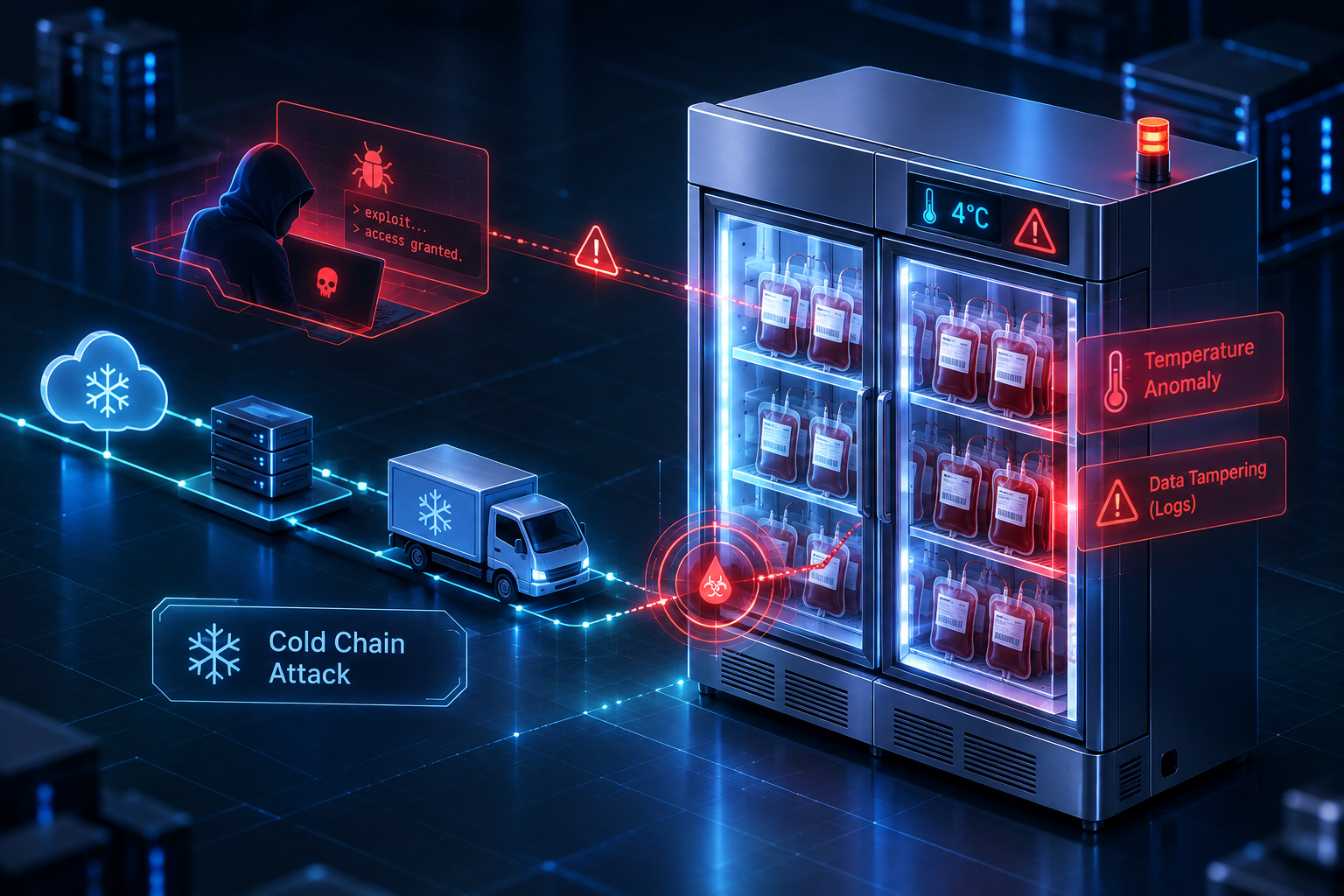
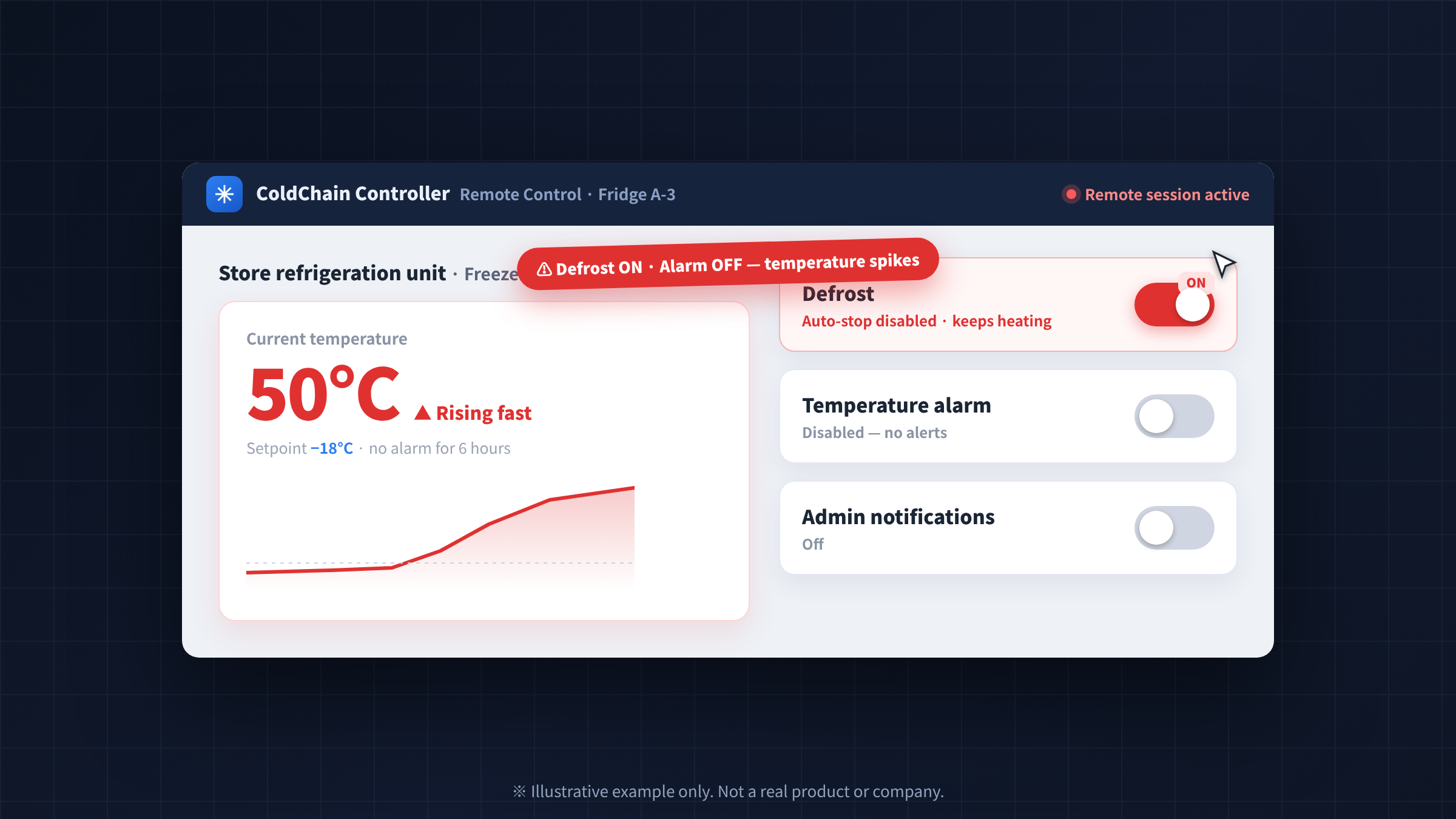
The attackers changed two settings. They turned the defrost function on and turned the temperature alarm off. As a result, freezers at about 700 supermarkets in France climbed to 50°C within six hours, and all the food was thrown out. Some stores even caught fire.
And when ZIEN looked up the same admin screen, about 2,900 devices were still open on the internet.
700 sites in one night, freezers at 50°C
The first attack took place across France on the nights between October 11 and 13. Refrigeration systems at about 700 supermarkets were manipulated remotely over the same period.
In early November it spread to more than ten European countries, including Belgium, the Netherlands, Germany, and Sweden. Around the same time, at three French blood centers, the setpoint of plasma freezers kept at minus 30°C was nearly changed to 110°C. An alarm went off, and the blood was only just saved.
Damage is estimated in the tens of millions of euros. French Economy Minister Roland Lescure told parliament that the attack had struck at the core of the country's food security. France treats the attack as sabotage rather than a money-driven crime, and has named a cyber unit of Iran's Islamic Revolutionary Guard Corps as being behind the October attack.
| When | What happened |
|---|---|
| October 11 to 13 | About 700 supermarkets in France see refrigeration temperatures rise to 50°C |
| November 1 to 2 | Spreads to more than ten European countries. Three French blood centers are also attacked |
| November 9 | The French government names a cyber unit of Iran's Islamic Revolutionary Guard Corps as being behind the attack |
The attackers turned defrost on and the alarm off
The attackers entered an equipment admin screen that was open on the internet and changed two settings. They left the defrost function, which melts frost, switched on, and they switched off the abnormal-temperature alarm. No malware was found.
How they got into the admin screen has not been established yet. Two possibilities are discussed. One is weak passwords, which France's national cybersecurity agency (ANSSI) sees as the likely cause. The other is an undisclosed vulnerability. The security firm Sekoia observed attempts in the November attack to take over admin accounts entirely without a password.
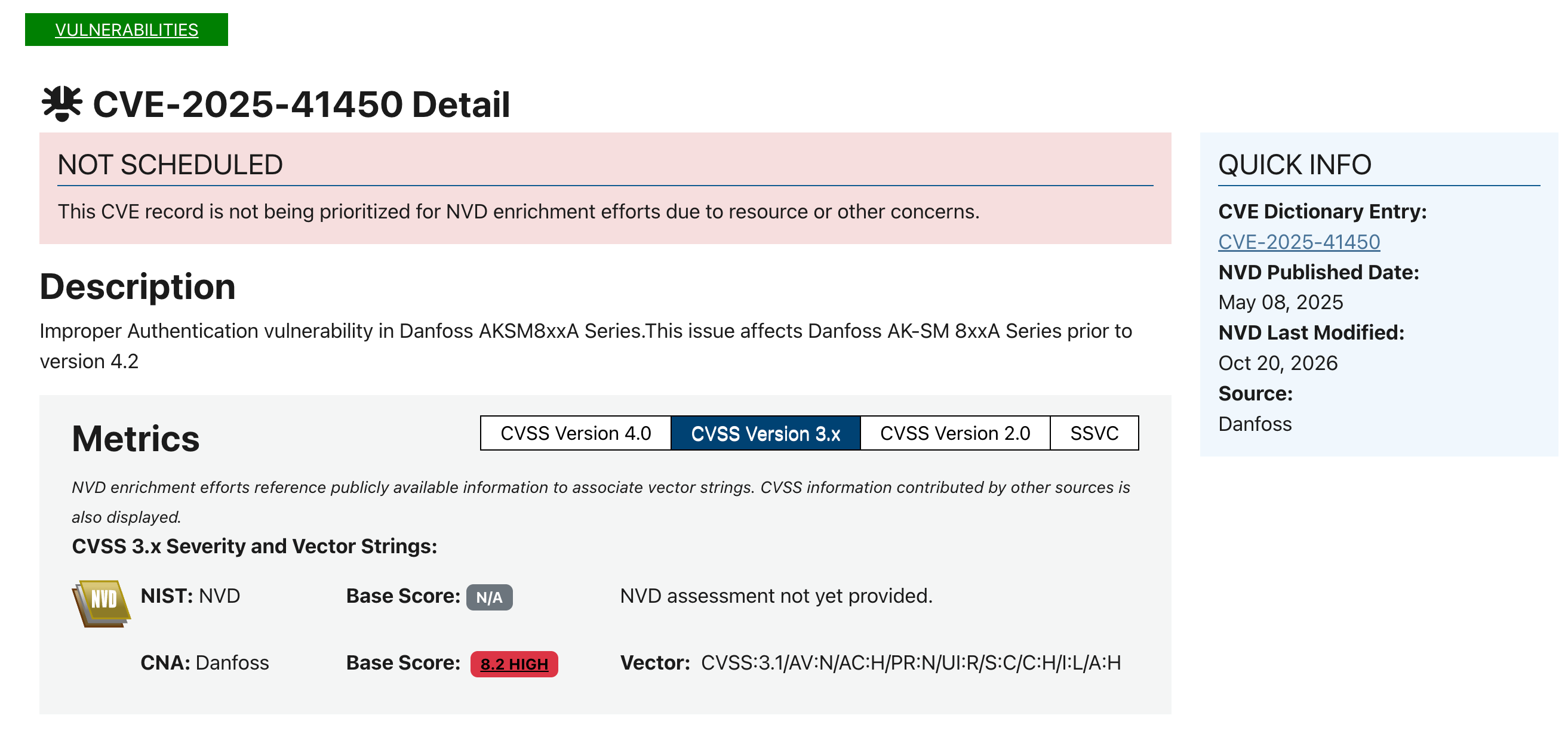
There is also a vulnerability that is already public. CVE-2025-41450, an authentication bypass in Danfoss controllers disclosed by the security firm Claroty in August this year, even has exploit code posted online that skips the login. ANSSI said it was not used in this attack. Unpatched devices, however, remain exposed to it.
2,900 devices are still open
ZIEN looked up the exposure using an internet asset search engine. About 2,900 Danfoss products had their admin screen exposed directly to the internet.
Pulling a list like this takes no specialist skill. Attackers can use the same list to try logging in to hundreds or thousands of devices at once. We believe that is how 700 sites were hit together in a single night.
A breached refrigerator also serves as an attack relay
A device with nothing to steal is still useful to an attacker. It is connected to the internet, and its owner rarely looks at it.
The security firm SecurityScorecard published evidence that refrigeration controllers exposed to the internet were abused as spam senders and attack relay points. One refrigeration controller in Namibia, Africa, carried 1.24 million outside connections, and another controller in the Caribbean was used by attackers to disguise their traffic as a home internet connection.
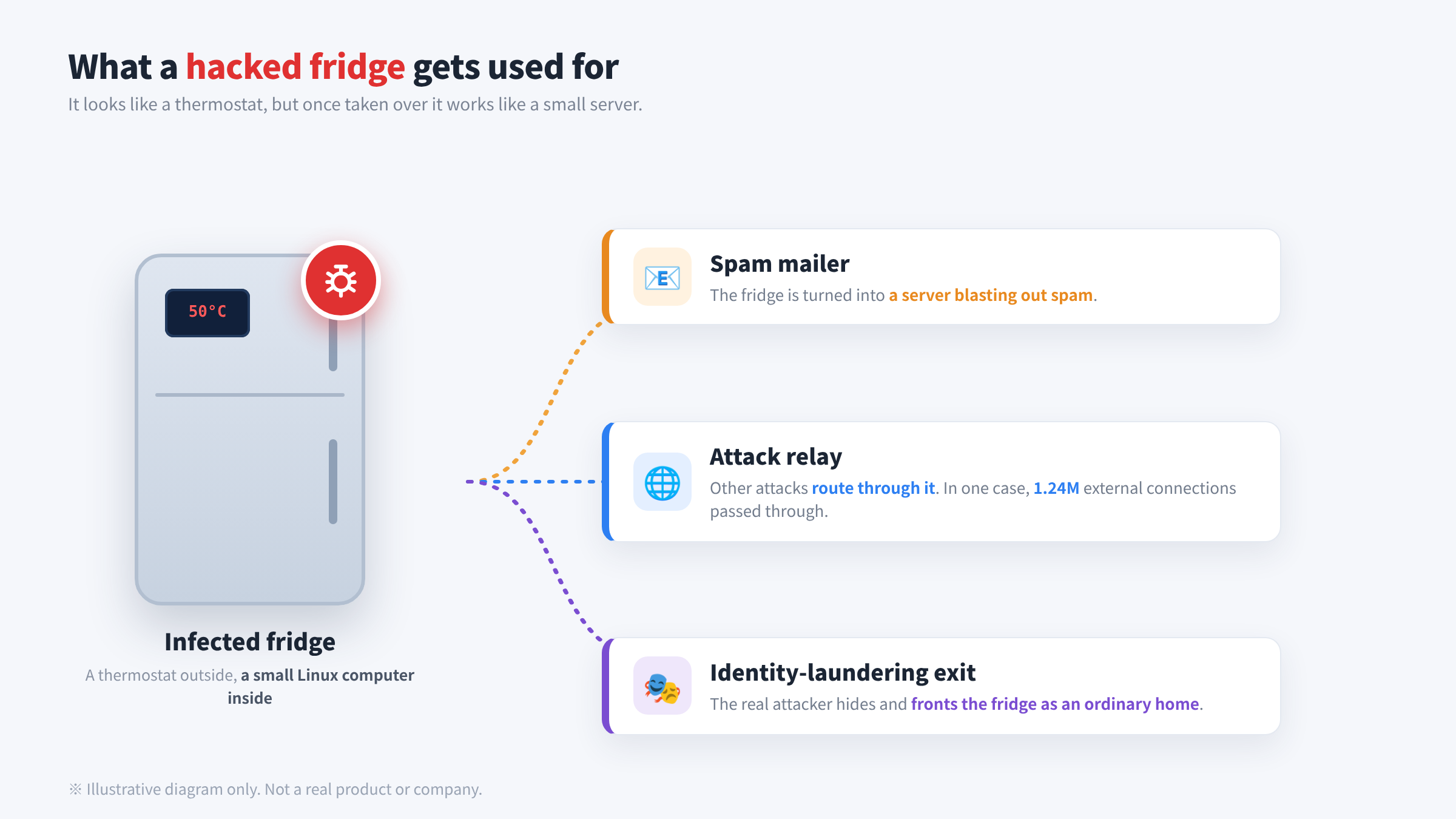
These cases are not directly linked to the temperature manipulation in Europe.
What about the refrigerator at home?
The targets this time were commercial store equipment, and it has not been confirmed whether the same method works on household refrigerators. But a smart refrigerator is also connected to the internet and controlled remotely through an app.
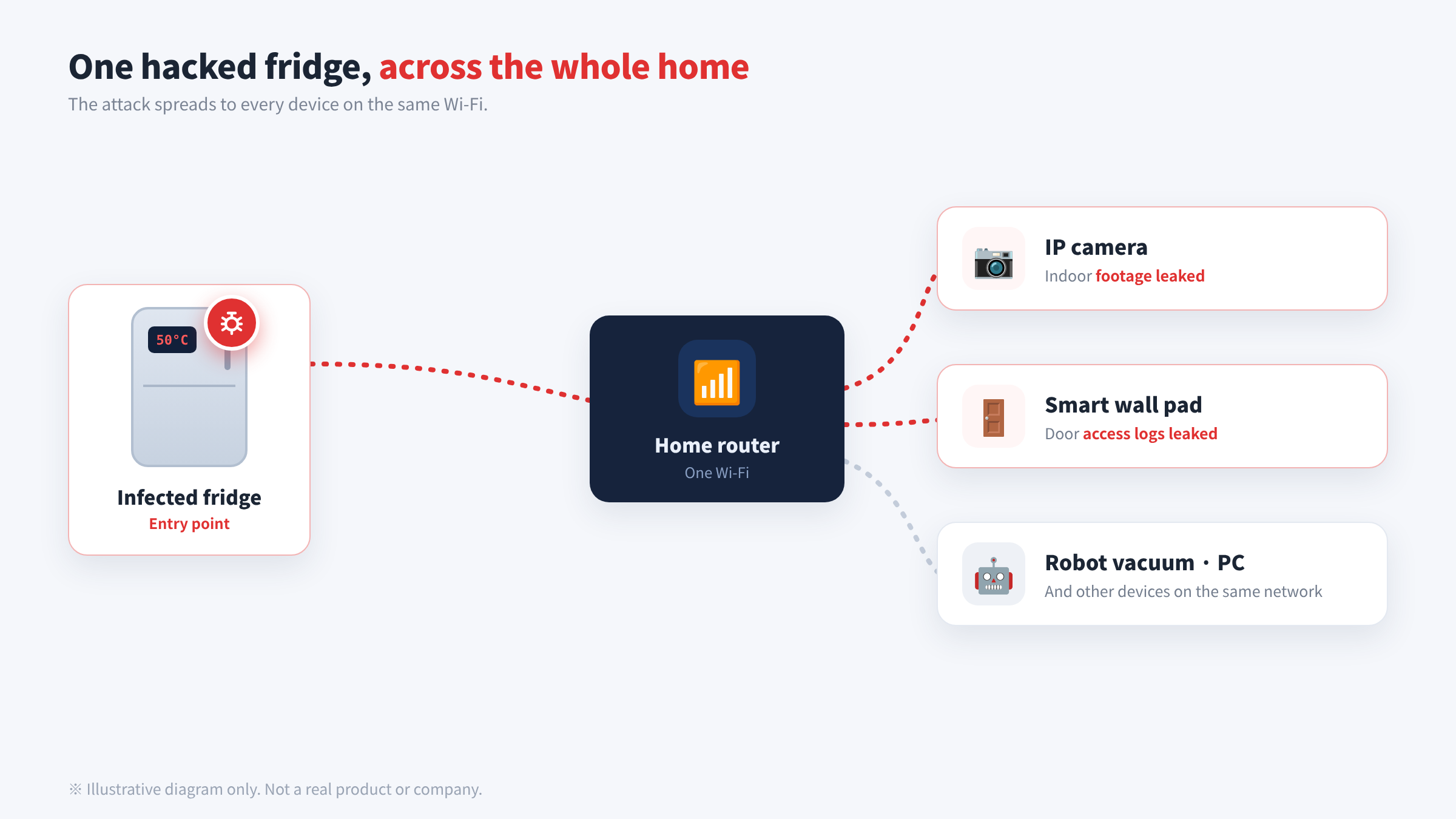
Once a refrigerator is breached, the attack can spread to the router, IP cameras, and wall pad (the smart home wall panel) on the same network. If an IP camera or wall pad is breached, video of the inside of the home and entry records leak out.
If it is used as a relay, the refrigerator is enlisted in attacks on other people, and the user has little way of knowing.
Five things manufacturers should check before launch
Users have little way of knowing whether a device has been breached, so the checking has to be done by the manufacturer before launch. For any product with remote management, check the following five points.
- Is the admin screen closed to the internet in the default configuration?
- Is the initial password different for each device, and is a change required at first login?
- Is there no path that skips the login in the web server and management APIs inside the firmware?
- Are there limits on remote changes to safety-critical functions such as defrost, alarm disabling, and temperature setpoints?
- Is there a channel for shipping a firmware update when a vulnerability is disclosed?
For products exported to Europe, these points are covered by the security requirements of the EU RED (Radio Equipment Directive) and the essential requirements of the EU CRA (Cyber Resilience Act). ZIEN's Z-IoT, an intelligent firmware security inspection platform, checks for these issues before launch through firmware and binary analysis, and supports the process of judging whether a discovered vulnerability is actually exploitable.
What this attack used was an admin screen open on the internet and two setting changes. By ZIEN's lookup, about 2,900 of the same admin screens are still exposed on the internet. We will add to this article once the intrusion path is confirmed.
References
- Sekoia, The cold chain on fire: unpatched Danfoss controllers exploited
- SentinelOne Labs, Defrost and Disrupt: an assessment of Europe's refrigeration attacks
- The Hacker News, France blames Iran for sabotage attack
- Boannews, Response in Korea by the Ministry of Science and ICT and KISA (in Korean)
- NVD, CVE-2025-41450
- SecurityScorecard, report on abuse of exposed refrigeration controllers